Who am I?
From a young age, we are encouraged to think on a basic level about “who we are.” We describe ourselves and others with simple, general adjectives such as smart, funny, kind and talented. These general terms are exactly what the definition is – general. We can give these simple, generic terms to anyone. It isn’t aimed at a specific person, but we still often describe ourselves as these virtues.
I chose philosophy as my 100-hour elective course this year, and this important question was posed to our class. Who am I?
I was researching Aristotle for a class research task when I came across this table.
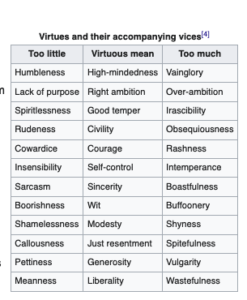
After reading this, and with the help of my friend’s explanation of what it meant, my mind started to think about some real-life examples.
This year, one of my goals is to become more confident in myself and my abilities, as well as working hard to achieve my ambitions.
We are encouraged to be confident in ourselves, but too little confidence makes us ‘insecure,’ and having too much confidence makes us ‘full of ourselves.’
We are encouraged to be ambitious, but too little ambition makes us have a ‘lack of purpose,’ and having too much ambition makes us ‘over-ambitious.’
My point is, when we are asked to describe ourselves – who we are – we describe ourselves with the general terms. Smart, funny, ambitious – these are just a few terms. But just how much of these terms are we? Because having too much of a virtue makes us excessive in that area, while having too little of that virtue makes us ‘mean’ or ‘weak.’
In the end, we need to have a balance. We can’t be seen to have too much, or too little of a virtue, but we need to contain enough so that the quality is ‘fulfilled.’